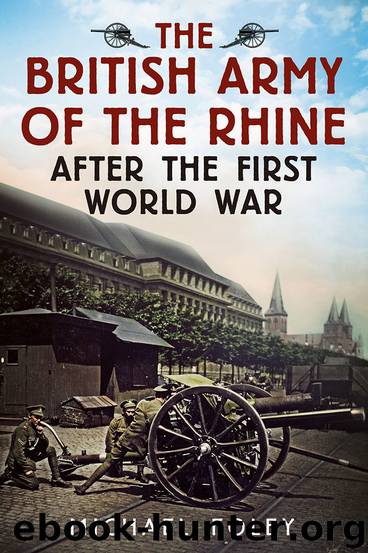
The British Army of the Rhine by Michael Foley
Author:Michael Foley
Language: eng
Format: epub
Publisher: Fonthill Media Limited
Published: 2017-04-06T04:00:00+00:00
4
1921
The year 1921 saw Britain in a great position in the world. This was according to Jan Smuts, Prime Minister of South Africa at the time; she said that the British Empire had emerged from the war as quite the greatest power in the world and only unwise or unsound policy could rob her of that position.
Those involved with the Empire were uppermost in the news and there was a question in Parliament asked by Major General Sir Newton Moore. Moore had a colourful background, having been premier of Western Australia, commander of the Australian forces in the United Kingdom during the war, and then a member of the British Parliament. If Smuts’ comment was true than Moore was maybe thinking that the keeping of the BAOR in Germany was one of those unsound policies. He asked how much the BAOR was costing. Sir A. Williamson answered that it had cost £51,900,000 up until the end of December 1920. The amount received from Germany had been 376 million Marks (£1,534,700).
Things were not so simple, however, and the coming of the new President Harding in America led to fears that America could make peace with Germany and then withdraw all its troops. It was believed by some that if the Americans withdrew, the British would leave as well and that the Germans would then not pay anything to France.
However, the decision to keep British troops on the Rhine was not really in doubt at this time. The year 1921 was thought to be one of the most difficult due to events outside the occupied area with numerous cases of disorder among the German population. It was not only in Germany that there were calls on the British forces. There was serious unrest in Ireland, with 50,000 British troops in the country.
The unrest in Upper Silesia was to have the most direct effect on the BAOR when four battalions were ordered to be sent to the area to keep order during the plebiscite that had been proposed by Lloyd George. It seemed as if it had been forgotten that since early 1918, an infantry brigade had been cut from four to three battalions, which would leave the force in Cologne very weak.
The newly created state of Poland had laid claim to the whole of Upper Silesia, which had not pleased the Germans. There had already been serious unrest in the area; this was to carry on for some time and involve British troops trying to keep the peace.
A decision by the League of Nations over the area added to the problems in Poland when they took away further land from Germany and gave more than half of Silesia to Poland. The population of the area had been split between the Germans and the Poles. It had also been the site of a very short seven-day war between Poland and Czechoslovakia in 1919, which had further altered the position of the border.
The industrial part of the area containing mines and steel works had
Download
This site does not store any files on its server. We only index and link to content provided by other sites. Please contact the content providers to delete copyright contents if any and email us, we'll remove relevant links or contents immediately.
| Africa | Americas |
| Arctic & Antarctica | Asia |
| Australia & Oceania | Europe |
| Middle East | Russia |
| United States | World |
| Ancient Civilizations | Military |
| Historical Study & Educational Resources |
The Radium Girls by Kate Moore(12036)
100 Deadly Skills by Clint Emerson(4932)
Rise and Kill First by Ronen Bergman(4797)
The Templars by Dan Jones(4695)
The Doomsday Machine by Daniel Ellsberg(4493)
The Rape of Nanking by Iris Chang(4224)
Killing England by Bill O'Reilly(4008)
Stalin by Stephen Kotkin(3973)
Hitler in Los Angeles by Steven J. Ross(3949)
12 Strong by Doug Stanton(3554)
Hitler's Monsters by Eric Kurlander(3348)
Blood and Sand by Alex Von Tunzelmann(3207)
The Code Book by Simon Singh(3197)
Darkest Hour by Anthony McCarten(3135)
The Art of War Visualized by Jessica Hagy(3014)
Hitler's Flying Saucers: A Guide to German Flying Discs of the Second World War by Stevens Henry(2759)
Babylon's Ark by Lawrence Anthony(2686)
The Second World Wars by Victor Davis Hanson(2529)
Tobruk by Peter Fitzsimons(2521)
